What OpenAI’s Ohio AI Campus Could Mean for Everyday Consumers
When people hear that OpenAI is planning to lease up to 8 gigawatts of data-center capacity at a technology campus in Pike County, Ohio, the immediate reaction may be: What does that have to do with me?
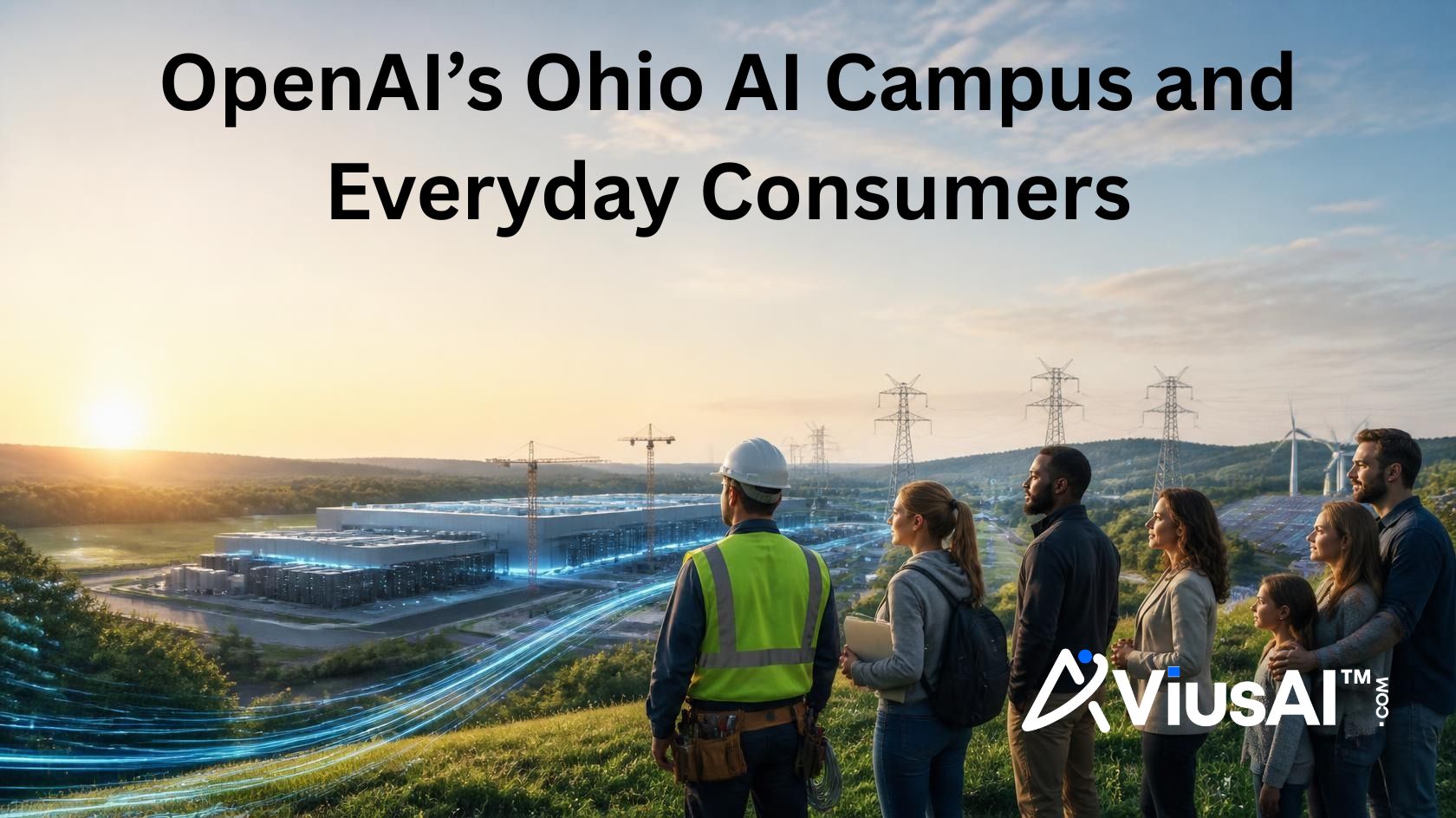
It sounds massive, technical, and distant more about substations, NVIDIA hardware, grid upgrades, and industrial construction than everyday life. But projects like the OpenAI and SB Energy development at the PORTS-Pike Technology Campus could shape the tools consumers use, the jobs communities rely on, the reliability and cost of electricity, access to education and training, and even how much trust people place in artificial intelligence.
For consumers, this is not merely a story about another data center. It is a test of whether the enormous investment now flowing into AI infrastructure can produce benefits that are visible outside Silicon Valley and outside corporate balance sheets.
The project is expected to be built over several years, potentially through 2032, and OpenAI says it could support thousands of construction jobs and thousands of long-term jobs. It also includes commitments for community grants, student access to AI tools, local engagement, and water-use transparency. Those promises are important. Still, consumers should look beyond the headlines and ask direct questions: Will this make AI tools better and more accessible? Will it create durable local opportunity? Who pays for the energy infrastructure? What happens to the environment? And will the people living near the project have a real voice as it grows?
Why a Data Center Matters to Consumers
A modern AI system does not live in a phone, laptop, or single office building. The familiar chatbot interface is only the visible tip of a much larger system. Behind it are data centers filled with specialized computing equipment, networking hardware, power systems, cooling equipment, backup infrastructure, and highly trained workers.
Large language models and other frontier AI systems require enormous amounts of computing capacity. They need it during the training process, when models learn from large datasets, and during daily operation, when millions of people ask questions, generate images, write code, analyze documents, or use AI within other products.
That is why companies such as OpenAI, NVIDIA, cloud providers, energy developers, and utilities are investing at a scale that can seem difficult to comprehend. A project measured in gigawatts is not a typical office expansion. It is regional infrastructure.
From a consumer perspective, the potential upside is straightforward: more computing capacity could mean faster, more capable, and more reliable AI services. It could reduce bottlenecks when demand rises. It may enable new applications that are currently too expensive, too slow, or too computationally demanding to be widely available.
Think about the difference between the early internet and today’s internet. At one time, sending a photo or streaming a video was slow, inconvenient, or impractical for many households. As network capacity, devices, and software improved, new consumer behaviors became normal. Video calls, online banking, streaming entertainment, GPS navigation, telemedicine, food delivery, and remote work all became easier because the supporting infrastructure matured.
AI may follow a similar path. Consumers could eventually use advanced AI as naturally as they use search engines, cloud storage, or smartphone maps. The quality of that future depends partly on whether the infrastructure is built responsibly.
Better AI Tools Could Become More Available
Consumers usually judge technology by experience, not by technical architecture. They care whether an AI tool is useful, affordable, private, available when needed, and easy to understand.
More AI computing capacity has the potential to improve several areas.
First, consumers may see faster and more dependable AI services. Anyone who has encountered slow responses, service limits, unavailable features, or usage caps has seen what happens when demand exceeds available capacity. More infrastructure can help reduce those constraints.
Second, expanded capacity may allow AI systems to handle more complex tasks. Instead of only drafting a quick email or answering a basic question, future tools could help consumers compare insurance documents, organize financial records, create study plans, translate conversations in real time, understand medical paperwork, prepare for job interviews, or plan a home repair project.
Third, better infrastructure can support more personalized experiences. A consumer may eventually have an AI assistant that understands their preferences, goals, schedule, documents, and household needs while giving the person meaningful control over what information is stored and how it is used.
For example, a homeowner might use AI to compare contractor estimates, identify questions to ask before signing an agreement, summarize inspection reports, track maintenance schedules, and organize receipts for insurance or tax purposes. A parent could use it to build customized learning materials. A small-business owner could use it to create marketing content, train employees, manage customer inquiries, and analyze cash flow.
The promise is significant, but it is not automatic. More computer capacity does not necessarily guarantee lower prices, stronger privacy, or more equitable access. Consumers should expect companies to compete not only on model capability, but also on value, transparency, safety, and service quality.
The Jobs Question Is Bigger Than Construction
OpenAI’s announcement emphasizes the potential for 35,000 construction jobs and 2,500 permanent jobs connected to the campus. From a consumer perspective, that matters because a large employment base can influence local incomes, housing demand, business activity, municipal services, and the long-term outlook of an entire region.
The construction phase could benefit electricians, equipment operators, welders, concrete workers, truck drivers, engineers, security personnel, project managers, and many other trades and support roles. Large technical campuses also create demand for local restaurants, hotels, suppliers, cleaning services, transportation providers, repair companies, and professional services.
For Southern Ohio, the question is whether those benefits stay local and last beyond the initial buildout.
Construction jobs are important, but they are temporary by nature. Permanent jobs are the real measure of a project’s long-term economic impact. Data-center operations may require technicians, network specialists, electricians, mechanical engineers, facilities managers, cybersecurity professionals, logistics coordinators, safety personnel, and administrative staff. Those are often skilled jobs, which makes training and access essential.
Consumers should pay attention to whether local residents can realistically qualify for these roles. A promise of thousands of jobs is much stronger if it includes clear pathways into them.
That means partnerships with community colleges, trade schools, high schools, apprenticeship programs, veterans’ organizations, and workforce-development groups. It means paid training, certifications, internships, and transparent hiring standards. It also means helping people who are changing careers, including veterans, displaced workers, and adults returning to education.
For someone with a background in telecommunications, network infrastructure, electrical systems, logistics, construction management, cybersecurity, or technical operations, this type of project could create a meaningful opportunity. The AI economy will not be made up only of software engineers in major tech hubs. It will also need practical professionals who understand uptime, redundancy, fiber connectivity, physical security, power systems, systems integration, supply chains, and disciplined project execution.
That is especially relevant for military veterans and infrastructure professionals. Many already have experience working in mission-critical environments where reliability, safety, documentation, chain of command, and contingency planning matter. Those skills transfer well to large-scale technology operations.
Community Investment Must Be More Than a Headline
OpenAI says it will contribute $40 million to a community grant fund, adding to a previous $40 million commitment from SB Energy. The money is expected to support priorities such as schools, health care, public safety, workforce training, housing, infrastructure, veteran services, small businesses, and working families.
From a consumer perspective, the dollar figure is encouraging. Yet the real value will depend on governance.
Community investment works best when local residents have genuine influence over decisions. A grant fund should not become a public-relations tool controlled entirely by outside corporations or a small circle of leaders. Residents should be able to understand how money is allocated, which projects receive support, what outcomes are expected, and whether those outcomes are achieved.
For example, a community may decide that workforce training is its highest priority. That could mean funding technical certification programs, transportation assistance for students, paid apprenticeships, equipment upgrades for local schools, or scholarships for residents entering electrical, IT, mechanical, and cybersecurity careers.
Another community might identify housing as the most urgent need. Large construction projects can increase demand for rentals and homes. That can benefit property owners, but it can also raise costs for renters and longtime residents. A thoughtful community fund could help support affordable housing, home-repair programs, rental assistance, or infrastructure that allows new housing to be built responsibly.
The key is local choice, not a one-size-fits-all corporate program.
Consumers and residents should want regular public reporting that answers simple questions:
- How much money has been committed and how much has been distributed?
- Who makes funding decisions?
- What projects received grants?
- How many local people benefit?
- Are funds reaching rural communities, working families, schools, and small businesses?
- What measurable results have been achieved?
Transparency builds trust. Without it, even a large financial commitment can feel abstract.
Electricity Costs Are a Consumer Issue
One of the biggest consumer concerns around large data centers is electricity.
AI facilities can require extraordinary amounts of power. That does not necessarily mean residential electric bills will rise, but consumers should not accept vague assurances. The issue is too important.
According to the announcement, SB Energy not regional utility customers will pay for required grid upgrades and transmission associated with the development. That is a meaningful commitment. In principle, it aims to prevent households and small businesses from subsidizing infrastructure built primarily for a very large private customer.
Still, consumers should watch how the project develops. Electricity systems are complex. Costs can arise through generation, transmission, distribution, grid balancing, backup power, long-term contracts, and regional planning. It matters who owns the infrastructure, who pays upfront, who bears risk if demand changes, and what happens if projected capacity is delayed or never fully used.
Consumers should also pay attention to the sources of power supporting the campus. The project’s first 800 megawatts could use existing AEP infrastructure, while further expansion would require additional generation, transmission, approvals, and investments. The announcement acknowledges that natural-gas generation may be part of the future power solution.
That creates a tension. Reliable power is essential for data centers. At the same time, consumers and communities increasingly care about energy affordability, air quality, emissions, and long-term resilience.
A responsible approach should include a diversified energy strategy: efficient operations, renewable generation where practical, energy storage, transmission planning, demand management, and clear environmental oversight. There is no single perfect answer, but there should be a public plan.
Consumers deserve to know whether the project improves local grid reliability, strains it, or does both at different stages. They also deserve clear information about how energy costs are allocated.
Water Use and Environmental Accountability
Data centers have become a focus of public debate because many use substantial water for cooling. This is particularly sensitive in areas facing drought, aging infrastructure, limited water capacity, or competing agricultural and residential needs.
The PORTS-Pike project says it plans to use closed-loop, air-cooled systems that recirculate water, and that OpenAI will disclose anticipated water use once the design is finalized. From a consumer standpoint, that is a reasonable starting point, but disclosure must be specific and ongoing.
A community should not have to guess how much water a major industrial campus will use, where that water comes from, how it is treated, what happens during peak heat, or how wastewater is managed. Those details affect local water systems, nearby households, public utilities, and environmental quality.
The phrase “closed-loop” can be positive because it suggests water is recirculated rather than constantly consumed. But the practical impact depends on engineering design, local climate, operating conditions, maintenance, and scale. A project of this size should publish understandable annual figures, not just technical language.
Environmental accountability should cover more than water. It should include land use, construction impacts, traffic, noise, emissions from backup generation, waste handling, habitat protection, and emergency planning.
Consumers do not need to oppose technology to demand environmental responsibility. In fact, broad public acceptance of AI infrastructure will depend on whether companies can show that they are planning responsibly, sharing information early, and responding meaningfully to local concerns.
Student Access May Be One of the Most Direct Benefits
OpenAI’s proposed provision of up to $84 million in Codex credits for eligible Ohio college, community-college, and technical-school students could be one of the project’s most tangible consumer-facing commitments.
The basic idea is that students should be able to access advanced AI tools without cost becoming an immediate barrier. If implemented well, this could help students explore coding, writing, research, business planning, data analysis, design, and technical problem-solving.
That matters because AI literacy is rapidly becoming part of workplace readiness. Students entering fields as varied as healthcare, construction management, marketing, manufacturing, finance, logistics, engineering, real estate, and public service may increasingly use AI tools in their daily work.
However, access alone is not enough.
Giving students credits is useful, but schools also need guidance on responsible use. Students should learn how to verify AI output, protect private information, identify errors, cite sources, avoid plagiarism, and use AI as a thinking partner rather than a substitute for learning.
A student studying cybersecurity, for example, might use AI to explain a networking concept, generate practice scenarios, review basic code, or organize study notes. But the student still needs to understand the concepts, validate the response, and recognize when an AI answer is incomplete or incorrect.
The best result would be a broader program that combines tool access with training for faculty, curriculum support, hands-on projects, local employer partnerships, and opportunities to build real skills.
For adult learners and career changers, community colleges and technical schools could be especially important. Many people do not have the time or financial flexibility for a four-year degree. Short, practical programs in network operations, industrial maintenance, fiber optics, cloud systems, data-center facilities, electrical work, and AI-enabled business operations can create pathways into growing industries.
Consumers Should Expect Privacy and Safety
As AI tools become more powerful and widely available, consumers will share more information with them. They may upload documents, ask personal questions, connect calendars, analyze financial information, draft legal or medical questions, or use AI at work.
That makes privacy and safety central consumer issues.
The infrastructure announcement focuses on capacity and community investment, but consumers should judge AI companies by more than the size of their campuses. They should also examine what happens to their data, how long it is retained, whether it is used to improve models, what controls are available, and whether users can understand the terms without needing a law degree.
Consumers should be able to make informed choices about sensitive information. They should know when a response may be uncertain. They should have ways to report harmful or misleading content. And they should not be forced to trade away basic privacy simply to use useful tools.
AI can be extremely helpful, but it can also generate plausible mistakes. A consumer using AI to review a lease, medical bill, loan agreement, repair estimate, or job offer should treat it as an assistant not as the final authority.
A good consumer habit is to use AI to generate questions, clarify unfamiliar language, compare options, and organize information. Then verify critical details through the actual provider, a qualified professional, official documentation, or a trusted source.
That balanced mindset helps consumers benefit from AI without becoming overly dependent on it.
What Success Would Look Like
The real measure of the Ohio project will not be its projected gigawatts or the number of servers installed. It will be the results people can see.
Success would mean local people gaining access to stable, skilled careers. It would mean construction and operating opportunities reaching regional businesses and workers, not only national contractors. It would mean workforce programs that lead to actual jobs.
Success would also mean the community grant fund produces visible improvements: better training programs, stronger schools, safer public services, support for veterans and small businesses, and housing solutions that help residents remain in the communities they call home.
It would mean energy infrastructure is financed fairly, with residential customers protected from costs that should be borne by the project. It would mean honest reporting on water use, environmental impact, construction progress, job creation, and community investments.
And, importantly, success would mean consumers experience useful AI that is more reliable, more affordable, easier to access, and safer to use.
The most promising version of this future is not one where AI becomes bigger for its own sake. It is one where advanced technology improves everyday capability. A small-business owner can compete more effectively. A student can learn more quickly. A veteran can translate military experience into civilian work. A homeowner can make more informed decisions. A rural community can attract jobs and investment without losing control over its resources or identity.
The Bottom Line for Consumers
OpenAI’s planned involvement in the PORTS-Pike Technology Campus represents the kind of large-scale investment that could influence both the national AI race and the economic future of Southern Ohio.
For consumers, the possible benefits are real: improved AI services, more reliable access to advanced computing, construction and technical employment, student tool credits, local business activity, and community funding. The project also recognizes important concerns by addressing grid-upgrade costs, proposing closed-loop cooling, and committing to future water-use disclosure.
But a consumer-friendly outcome is not guaranteed by announcements alone.
People should expect measurable commitments, public transparency, local hiring pathways, responsible environmental practices, fair electricity-cost allocation, meaningful privacy protections, and a genuine role for the community in deciding how investment dollars are spent.
This is the larger lesson of the AI era. The technology may be global, but its effects are local. They show up in power bills, job listings, school programs, housing costs, small-business opportunities, data privacy, and the quality of the tools people use every day.
The question is not whether AI infrastructure will be built. It already is.
The question is whether consumers and communities will receive a fair share of the benefits and whether companies building the next generation of AI will earn the public trust required to sustain it.