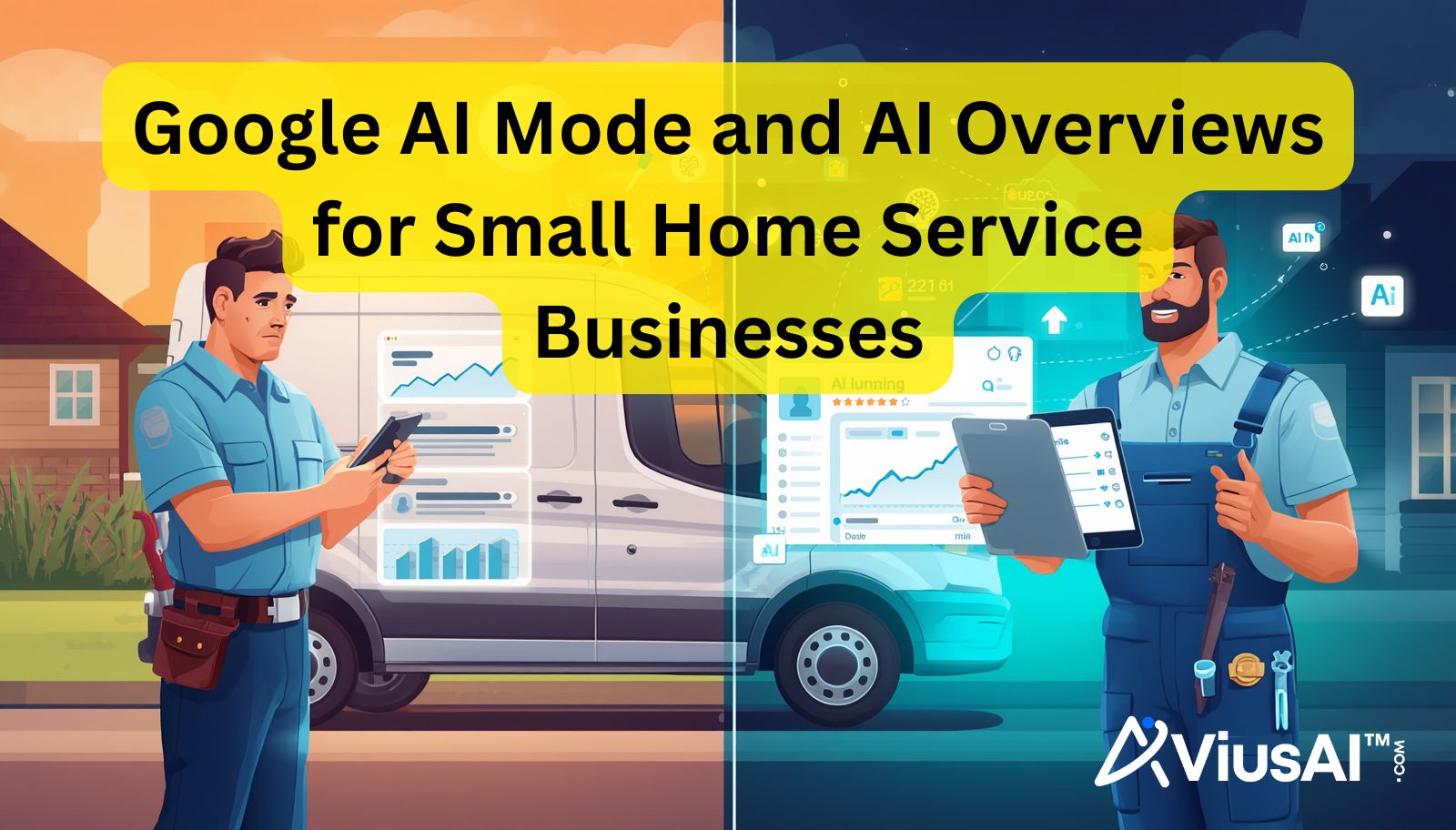
How Google AI Mode and AI Overviews Are Reshaping SEO for Small Home Service Businesses in 2026
Introduction: The Search Landscape Has Changed Forever
If you run a plumbing company, HVAC business, electrical service, or any home service trade, you’ve probably noticed something strange happening to your website traffic over the past year. Maybe your Google rankings look fine on paper, but your phone isn’t ringing as much. Or perhaps you’re seeing fewer clicks even though you’re still on page one for your target keywords. You’re not imagining it – Google’s search results have fundamentally changed, and the old SEO playbook no longer works the way it used to.
In 2026, Google has rolled out AI Mode to users across 180+ countries and 35+ new languages, fundamentally transforming how people find home service businesses online. At the same time, AI Overviews now appear in approximately 13% of all search queries, directly answering user questions without requiring a click through to websites. This isn’t a minor algorithm tweak – this is a complete restructuring of how search works, and small home service businesses need to adapt fast or risk becoming invisible to the customers who once found them easily.
The businesses that thrive in this new environment aren’t necessarily those with the biggest marketing budgets. They’re the ones who understand what’s happening, why it matters, and – most importantly – what to do about it. This guide will walk you through everything you need to know about Google AI Mode and AI Overviews, how they impact your home service business, and the specific actions you can take to protect and even grow your online visibility in 2026 and beyond.
What Is Google AI Mode and Why Should You Care?
Google AI Mode represents an end-to-end AI search experience that goes far beyond traditional search results. Instead of simply returning a list of blue links with descriptions, AI Mode engages users in conversational queries, provides synthesized answers pulled from multiple sources, and can even perform multi-step tasks like comparing prices, scheduling services, or finding the nearest available technician.
For homeowners, this means they can ask questions like “I have a leaky water heater in my basement and it’s making a grinding noise – what’s the most likely problem and how much should I expect to pay to fix it in the Sacramento area?” and receive a comprehensive answer that includes troubleshooting steps, estimated repair costs, weather considerations, and a list of nearby plumbers with availability – all without clicking through to multiple websites.
For your home service business, this creates both a threat and an opportunity. The threat is clear: if AI Mode answers the customer’s question directly, they might never visit your website, click your ads, or even see your business listing. The opportunity is equally real: if your business is properly optimized and cited in AI-generated responses, you could gain visibility across thousands of queries that previously would never have shown your business at all.
Google is also making AI Mode more accessible by allowing users to access it directly from the Chrome address bar, with full rollout expected by September 2026. This means AI search will become even more seamless and integrated into everyday browsing behavior, further normalizing AI-first search among home service customers.
AI Overviews: The Silent Traffic Killer (and Opportunity)
AI Overviews are the AI-generated answer boxes that now appear at the top of Google search results for many queries. Instead of scrolling past them to find traditional organic results, users often get their answer immediately within the AI Overview itself. For home service businesses, this creates a challenging dynamic.
Consider this scenario: A homeowner searches “why is my air conditioner blowing warm air” and AI Overview provides a detailed troubleshooting guide covering thermostat settings, dirty filters, low refrigerant, and when to call a professional. The homeowner reads the answer, realizes they need a technician, and clicks on one of the recommended businesses in the AI Overview, or worse, never clicks through to any website at all because they already have the information they needed.
The statistics are striking: AI search traffic has increased 527% in just one year, and AI Mode now serves 75 million daily users. Meanwhile, AI Overviews appear in 13% of all queries, and that percentage is growing. For small home service businesses that traditionally relied on organic search traffic for 30-50% of their leads, this represents a existential challenge that cannot be ignored.
However, there’s a critical nuance many business owners miss: AI Overviews with ads are now being rolled out to English-speaking markets. This means Google is monetizing AI answers directly, and businesses that don’t pay for ads might be completely excluded from AI-generated responses for competitive commercial queries.
How AI Search Actually Works (And Why It Matters for Your Business)
Understanding how AI search works is essential to optimizing for it. Traditional SEO focused on ranking for specific keywords – getting your page to appear on page one for “emergency plumber San Antonio.” AI search operates differently. Instead of matching keywords, AI systems like Google’s AI Mode, ChatGPT, Perplexity, and Claude analyze your entire business presence across the web to generate synthesized answers.
When someone asks AI “find me an emergency plumber near me who can come out within an hour,” the AI doesn’t just look at keyword matching. It evaluates:
- Your business citations and consistency across Google Business Profile, Yelp, Facebook, Angi, and other directories
- Your review velocity and sentiment (are you getting positive reviews recently?)
- Your content quality and expertise (does your website demonstrate genuine knowledge?)
- Your technical reliability (is your site fast, mobile-friendly, and accessible?)
- Your third-party mentions (are other reputable sites citing or linking to your business?)
- Your availability signals (do you have real-time scheduling data that AI can access? (We can help with this.)
The AI then synthesizes this information into a response that often includes multiple business recommendations with brief descriptions, rather than linking to a single “winner”. This fundamentally changes what matters for visibility: authority and trustworthiness across your entire digital footprint matter more than ever, while traditional on-page keyword optimization matters less.
For home service businesses, this means your Google Business Profile is now more critical than your homepage. Your Yelp reviews might matter more than your service page content. Your pricing transparency on third-party platforms might matter more than your FAQ section. The AI is aggregating signals from everywhere, not just optimizing for your website’s internal SEO structure.
The Specific Impact on Home Service Industries
Different home service sectors are experiencing the AI search transition differently. Understanding these nuances helps you prioritize your efforts.
Emergency Services (Plumbing, Electrical, HVAC)
Emergency service businesses are experiencing the most dramatic disruption. When someone has a burst pipe or no heat in winter, they search with urgency. AI Overviews now provide immediate troubleshooting steps that can delay or prevent the call entirely. However, when the AI determines professional help is needed, it tends to recommend businesses with:
- Immediate availability (real-time scheduling data. We can help with this.)
- Strong emergency service signals (clear messaging about 24/7 availability)
- High review velocity (recent positive reviews)
- Transparent pricing (upfront estimates in AI responses)
Businesses that have AI-integrated scheduling systems and real-time availability data are gaining significant advantages, as AI can directly surface businesses that can respond immediately.
HVAC and Seasonal Services
HVAC businesses face unique challenges during seasonal transitions. AI Overviews now provide maintenance checklists and DIY troubleshooting guides that can reduce service call volume during off-peak seasons. However, businesses that create seasonal content optimized for AI (maintenance schedules, seasonal preparation checklists, energy efficiency tips) see increased visibility during shoulder seasons when AI is more likely to recommend professional service.
The key is creating content that answers the questions AI is already asking. For example, if AI is generating answers about “when should I service my AC before summer,” having comprehensive, authoritative content on that exact topic increases your chances of being cited in the AI response.
General Home Services (Cleaning, Landscaping, Pest Control)
These services are experiencing mixed results. AI Overviews provide DIY alternatives for basic cleaning and landscaping tasks, reducing organic traffic for information-seeking queries. However, for complex or high-value services (full home cleaning contracts, landscape design, pest elimination), AI tends to recommend businesses with strong local presence and verified credentials.
The businesses winning in this space are those that:
- Document their process with photos and videos (AI favors visual content)
- Showcase before/after results with specific metrics
- Maintain consistent NAP (name, address, phone) across all directories
- Collect and respond to reviews within 24-48 hours
What You Need to Do Right Now: A 10-Step Action Plan
The good news is that adapting to AI search doesn’t require rebuilding your entire business from scratch. Here’s a practical, prioritized action plan based on what’s working in 2026:
1. Optimize Your Google Business Profile as Your Primary Asset
Your Google Business Profile (GBP) is now arguably more important than your website for AI search visibility. Complete every section: hours, services, service areas, photos, products, and business attributes. Add 20+ high-quality photos showing your work, team, and vehicles. Post weekly updates about seasonal services, promotions, or educational content. Respond to every review within 24 hours, and encourage satisfied customers to mention specific services in their reviews.
2. Create Copy-Ready Content Assets
AI systems favor content that’s easy to extract and reference. Add comparison tables (e.g., “Water Heater Repair vs. Replacement: When to Choose Each”), checklists (e.g., “10 Signs Your HVAC System Needs Professional Service”), and numbered lists with specific statistics. Avoid vague claims like “we provide excellent service” – instead use specific, measurable statements like “we arrive within 60 minutes for emergency calls, 95% of the time”.
3. Implement Structured Data (Schema Markup)
Add FAQSchema and HowToSchema to your service pages and blog posts. This helps AI understand your content structure and extract answers more easily. For home service businesses, also implement LocalBusiness schema with complete service area information, accepted payment methods, and service credentials. Most WordPress sites can add schema using plugins like RankMath or Schema Pro without custom coding.
4. Target “People Also Ask” Questions
Google’s “People Also Ask” boxes are strong indicators of what AI is synthesizing for answers. Use tools like AnswerThePublic or Google’s own autocomplete to find questions your customers are asking. Create content that directly answers these questions in the first 100 words, using clear headings and bullet points. For example, if “how much does water heater repair cost in [city]” appears in People Also Ask, create a dedicated page with current pricing for your area.
5. Build Third-Party Authority Through Citations and Mentions
AI systems weigh third-party mentions heavily. Get listed on Angi, HomeAdvisor, Yelp, Facebook, and industry-specific directories with consistent NAP information. Pitch your expertise to local news outlets for home maintenance tips, emergency preparedness guides, or seasonal advice. Participate in local community organizations and get mentioned on their websites. These external signals are critical for AI trustworthiness assessments.
6. Track AI Visibility, Not Just Rankings
Traditional rank tracking tools don’t measure AI visibility. Use tools that track AI citations and visibility across Google AI Mode, ChatGPT, and Perplexity. Monitor whether your business appears in AI responses for your target queries. Some tools like Perplexity’s own search and specialized AI SEO platforms can show you when your business is cited in AI-generated answers.
7. Optimize for AI Crawl Access
Ensure your robots.txt file doesn’t block GPTBot (OpenAI’s crawler), PerplexityBot, or other AI crawlers from accessing your content. Most home service businesses don’t need to block these crawlers, in fact, you want them to index your content thoroughly. Check your WordPress SEO plugin settings to ensure AI crawlers are allowed.
8. Add Visual Content and Demonstrations
AI systems cite content with images, videos, and data visualizations more frequently. Create short YouTube videos demonstrating common problems (e.g., “How to Tell If Your Water Heater Is Leaking”), embed them on your site, and optimize with descriptive titles and transcripts. Add schematics, diagrams, and before/after photos to your service pages.
9. Consider AI Search Ads
With Google rolling out ads within AI Overviews for English-speaking markets, traditional organic visibility might not be enough for highly competitive commercial queries. Test AI-focused ad campaigns targeting the types of conversational queries AI Mode handles. These ads appear directly in AI-generated responses, giving you visibility even when AI answers the question directly.
10. Develop Your Unique Value Proposition for AI
AI systems need to differentiate between businesses when making recommendations. Develop clear, specific differentiators that AI can cite: “only local plumber with 20+ years specializing in tankless water heaters,” “same-day service guarantee or $50 off,” “licensed, insured, and certified by [specific organization]”. Avoid generic claims that don’t help AI distinguish you from competitors.
The Timeline: What to Expect in the Next 12 Months
Understanding the evolution of AI search helps you plan strategically. Here’s what’s coming:
June-September 2026: Google AI Mode rollout accelerates with Chrome address bar integration. AI Overviews expand to more commercial queries. Businesses that optimize now will establish early authority that compounds over time.
Late 2026: AI Overviews with ads become mainstream for English markets. Paid visibility in AI responses becomes critical for competitive home service keywords. Organic-only strategies become increasingly risky.
2027: AI search traffic is projected to represent 50%+ of all search traffic for informational queries. Businesses that have adapted will see sustained growth; those that haven’t will face dramatic traffic declines.
2027-2028: AI agents will increasingly handle multi-step tasks like comparing multiple plumbers, checking availability, and even scheduling appointments directly. Businesses with AI-integrated scheduling and real-time data will capture disproportionate market share.
Common Mistakes Home Service Businesses Are Making
Based on industry analysis, here are the most common pitfalls to avoid:
Mistake #1: Ignoring AI search and continuing with 2024 SEO strategies. This is like trying to win in 2026 with 2015 tactics. The rules have changed, and what worked before no longer works the same way.
Mistake #2: Focusing only on website SEO while neglecting Google Business Profile and third-party citations. AI aggregates signals from everywhere, not just your website.
Mistake #3: Using vague, generic claims instead of specific, measurable differentiators. AI can’t distinguish between businesses that all say “excellent service” and “professional technicians.”
Mistake #4: Blocking AI crawlers thinking it protects content. This prevents AI from understanding your business, making you invisible in AI-generated responses.
Mistake #5: Not modernizing the front end customer experience. Most customers want immediate information and appointment booking, not for you to miss their phone call. Most new customers will simply not leave a voicemail if you are busy on the job and can not answer your phone.
Remember how Google is checking for “Your availability signals” (above)? This is what they mean.
The Bottom Line: Adapt or Risk Irrelevance
Google AI Mode and AI Overviews aren’t temporary experiments, they’re the future of search. With 75 million daily AI Mode users already and Chrome integration coming by September 2026, AI-first search is becoming the default behavior for home service customers. The 527% year-over-year increase in AI search traffic shows this isn’t a trend; it’s a fundamental shift.
For small home service businesses, the challenge is significant but not insurmountable. The businesses that succeed will be those that:
- Treat their digital presence as a unified ecosystem (GBP, website, citations, reviews all work together)
- Create content specifically designed for AI extraction (tables, checklists, specific data points)
- Build third-party authority through citations, reviews, and media mentions
- Track AI-specific metrics and adapt based on what’s working
- Embrace AI integration for scheduling, availability, and customer communication (Avius AI)
The good news is that you don’t need to be a technology expert or hire a massive marketing team. The strategies outlined above are actionable today, require modest investment, and can be implemented by small business owners with basic technical skills. The key is starting now, before AI search becomes even more dominant and the competitive advantage of early adopters compounds.
Your customers are already using AI to find home service businesses. The question isn’t whether you should adapt to AI search – it’s whether you’ll adapt quickly enough to stay visible to the customers who once found you easily. The time to act is now, before your competitors establish AI authority that becomes increasingly difficult to displace.