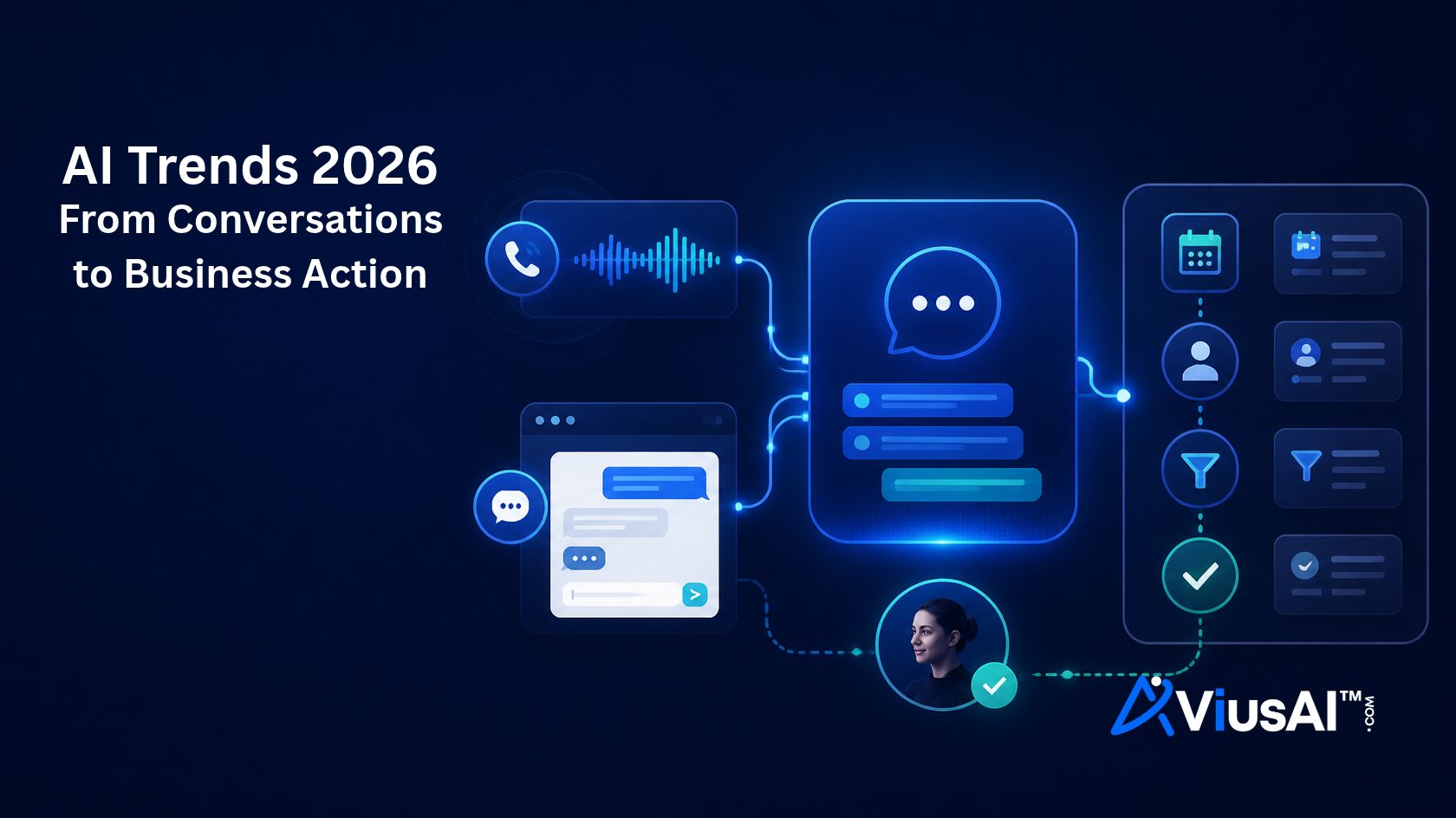
Explore the latest AI trends in 2026, from voice agents and business discovery to security, regulation, and practical automation strategies with Avius AI, covering agentic AI, AI voice agents, conversational AI for business, customer service automation, AI business solutions.
AI Trends 2026: From Impressive Conversations to Accountable Business Automation
Artificial intelligence is entering a more demanding chapter. The conversation is no longer just about what a model can write, summarize, or explain. It is increasingly about what an AI system can accomplish, which business systems it can access, and who remains responsible when it takes action.
The latest AI trends in 2026 make that shift tangible. On November 10, OpenAI announced business profiles and business-facing agents within ChatGPT. That same day, IBM and Microsoft announced an enterprise platform designed to connect AI agents with industry-specific processes. Meanwhile, companies are drawing boundaries around how outside agents access their services. These developments point toward an emerging reality: AI is becoming part of the infrastructure through which customers discover businesses and get things done.[reuters][news.microsoft][thenewstribune]
For business owners, the challenge is separating useful change from expensive distraction.
At Avius AI, the relevant question is practical: How can conversational AI help businesses respond to customers, support employees, and move work forward without sacrificing control? Avius AI’s voice and web solutions focus on those customer-facing interactions, including lead qualification, call routing, website engagement, and workflow triggers.[aviusai]
Here is what the current AI landscape means for businesses – and how to approach it with a clear plan.
1. Agentic AI Is Moving Beyond the Demonstration Stage
One of the defining developments in artificial intelligence is the move from generating responses toward executing connected business tasks.
A conversational assistant might explain how to book an appointment. An agent-enabled workflow can potentially collect the required information, check an approved scheduling system, and request or complete a booking within its assigned permissions. The distinction is not simply that one sounds more intelligent. It is that the second connects conversation with action.
The IBM–Microsoft announcement illustrates this direction. Their Imagine Enterprise platform is designed to help organizations build, run, and govern agents that work with enterprise data and industry-specific processes. The announcement emphasizes human expertise, controls, observability, and compliance support alongside automation.[news.microsoft]
That combination matters. An agent’s usefulness depends on more than the quality of its language.
For a customer-facing workflow, the real questions include:
- Does it have access to accurate business information?
- Can it use the right tools without receiving unnecessary permissions?
- Does it recognize when approval is required?
- Can employees understand what happened afterward?
Consider a hypothetical home services business. Answering a caller’s question about service areas is one task. Collecting the address, identifying the requested service, checking availability, and passing a complete request to dispatch is another.
The opportunity is not unlimited autonomy. It is a carefully defined path from customer intent to an appropriate business outcome.
2. AI Is Becoming a New Business Discovery Channel
AI is also changing where customer relationships can begin.
On November 10, Reuters reported that OpenAI was launching “Businesses” in beta within ChatGPT. Companies could claim and manage profiles, update information, and track user engagement. A separate “Business Agents” feature would let users ask participating businesses about products or services, initially rolling out to eligible e-commerce and online service businesses in the United States.[reuters]
For business leaders, this creates an important distinction: being discoverable and being ready to respond are different responsibilities.
A customer may encounter a business through an AI interface before visiting its website or making a phone call. That makes accurate business information increasingly valuable. An outdated service description or inconsistent operating schedule can create confusion before an employee ever joins the conversation.
A practical response starts with information hygiene:
- Maintain consistent business names, contact details, and service descriptions.
- Explain geographic coverage and operating hours clearly.
- Publish useful answers to genuine customer questions.
- Keep policies and eligibility requirements current.
- Make the next step obvious.
None of this guarantees visibility in an AI platform. It does, however, create a stronger information foundation.
The broader lesson is straightforward: customer acquisition and customer service are becoming more closely connected. A business needs accurate information where customers discover it and a reliable process when they decide to engage.
3. Voice AI Brings Automation to a Familiar Customer Channel
While new AI interfaces attract attention, the telephone remains central to Avius AI’s customer-service offering. The company describes voice solutions for answering inquiries, qualifying leads, routing calls, and triggering workflows, alongside conversational support on websites.
The strategic appeal is easy to understand. Businesses do not always need customers to adopt a new interface. They can improve an interaction customers already know: calling with a question or requesting help.
However, a natural-sounding voice should not be the sole purchasing criterion.
A sensible evaluation asks whether the system handles the situations that matter to the business. Can it accurately repeat an address? Does it avoid promising an appointment before availability is confirmed? Can it recognize an urgent request and follow the designated escalation procedure?
For a hypothetical property management company, routine questions might concern office hours, application requirements, or maintenance intake. Sensitive disputes and emergencies need a different path.
The strongest implementation plan separates those categories before launch.
A useful voice agent should know both how to continue and when to stop. An elegant conversation that produces the wrong operational result is still a failed interaction. The goal is dependable service, not a convincing imitation of a person.
4. Integration Is Becoming More Important Than Conversation Alone
The enterprise announcements also highlight another shift: attention is moving toward connecting agents with existing data and daily work. IBM and Microsoft explicitly position their platform around that connection. Avius AI similarly describes external-system integrations and workflow triggers within its agentic offering.[news.microsoft][aviusai]
For buyers, this suggests a more useful evaluation method.
Instead of asking only, “What can the AI say?” ask, “What happens after the conversation?”
An effective inquiry-handling process might need to:
- Capture the customer’s request.
- Check relevant business rules.
- Record information in the appropriate system.
- Notify the responsible employee.
- Confirm the next step without overstating completion.
Each transition deserves attention.
For example, “Your request has been submitted” and “Your appointment is confirmed” are not interchangeable. The first describes intake. The second implies a completed scheduling action.
Businesses should document those distinctions in plain language. They should also decide what happens when an integration is unavailable or a record cannot be updated.
This is where implementation becomes operational design. A well-written response cannot compensate for an unclear handoff, a missing permission, or a broken connection. The workflow must be coherent from beginning to end.
5. Agent Access Is Becoming a Business Policy Decision
Not every organization wants outside agents operating on its platforms.
On November 11, Reuters reported that United Airlines would restrict AI bots’ access to its digital services, citing data security concerns. The airline warned that sharing credentials with third-party assistants could expose sensitive information or lead to unintended purchases, account changes, or unauthorized use of frequent-flyer miles.[thenewstribune]
This development adds an important counterweight to the enthusiasm around autonomous agents.
Technical capability is not the same as authorization. A tool may be able to navigate a website without having permission to use it in a particular way.
For businesses deploying automation, the implication is practical: confirm that intended integrations are supported and permitted. Do not build a critical process around assumed access to someone else’s systems.
For businesses receiving automated traffic, the questions run in the other direction:
- Which agent interactions will we allow?
- What identity or authorization checks are required?
- Which actions need customer confirmation?
- How will we distinguish approved integrations from unwanted access?
These are not merely technical settings. They affect customer trust, commercial relationships, and operational risk.
The next phase of AI adoption will involve negotiation over access as much as innovation in capability. Responsible automation respects the boundaries of every system involved.
6. AI Security Must Include Actions, Not Just Answers
When an assistant only produces text, reviewing the answer is an obvious control. When an agent can interact with business systems, reviewing the action becomes just as important.
Recent product announcements reflect this concern. Cisco’s November announcement describes new red-teaming and agent-observability capabilities intended to help enterprises test and monitor increasingly capable AI systems. IBM and Microsoft likewise emphasize governance and observability in their enterprise platform.[news.microsoft][newsroom.cisco]
For a business evaluating AI tools, those themes translate into concrete questions:
- What information can the agent read?
- Which records can it change?
- Can permissions be restricted by task?
- Which actions require approval?
- What activity is logged?
- How can access be revoked?
A useful design principle is to grant only the access required for a defined job.
An assistant answering service-area questions does not need the same permissions as a system issuing refunds. A tool collecting appointment preferences may not need authority to cancel existing bookings.
Testing should also include failure scenarios, not just ideal conversations. What happens when a customer provides contradictory information? When an external service stops responding? When someone asks the agent to ignore its instructions?
The objective is not to eliminate every possible uncertainty. It is to create boundaries that make errors easier to detect, contain, and correct.
7. AI Regulation Is Now an Operational Consideration
Regulation is another reason businesses need a clear understanding of their AI deployments.
The European Commission’s AI Act implementation timeline identifies August 2, 2026, as the point when the majority of rules came into force, while other requirements follow later milestones. The timeline separates different obligations and application dates rather than treating the legislation as one universal deadline.[ai-act-service-desk.ec.europa]
That distinction matters for organizations evaluating compliance claims.
“AI compliant” is not a useful standalone description without explaining which law, which role, which system, and which obligations are involved.
A business should first establish what it is actually deploying. Is the tool answering routine questions, supporting an employment decision, generating content, or performing another function? Where is it used, and who interacts with it?
From there, appropriate legal and privacy review can address the relevant requirements.
Operational preparation can begin with a simple inventory:
- The AI tools in use.
- The business purpose of each tool.
- The information each tool receives.
- The actions each tool may perform.
- The employee responsible for oversight.
- The process for reporting problems.
This is not a substitute for legal advice. It is a practical foundation for obtaining useful advice and managing systems consistently. Regulation becomes easier to address when the organization can accurately describe its own technology.
8. The Right AI Metrics Connect Activity With Outcomes
Major enterprise launches and continuing investment show substantial commercial attention around agents. For example, Reuters reported on November 11 that AI agent developer Rox raised $100 million at a $1.3 billion valuation. That is evidence of investor interest, not proof that every business deployment will deliver a return.[reuters]
For individual companies, the relevant evidence must come from their own operations.
A customer-service pilot should start with a baseline. How many inquiries arrive? How many receive no response? How often do employees need to correct information? How many qualified inquiries reach the next step?
Then choose measures that match the workflow.
For voice and website interactions, useful candidates include:
- Successfully completed requests.
- Accurate lead information.
- Appropriate transfers to employees.
- Confirmed versus failed bookings.
- Customer complaints and correction requests.
- Cost per successfully completed interaction.
Avoid treating automation volume as a complete success measure. An agent that handles many conversations but leaves customers confused may create additional work elsewhere.
Likewise, a high transfer rate is not automatically bad. If transfers happen because the system correctly recognizes sensitive or exceptional cases, they may demonstrate sound boundaries.
The question is not simply how much work the AI touches. It is whether the overall process becomes more useful, reliable, and economical.
9. Employees Need Defined Roles in AI-Enabled Workflows
The IBM–Microsoft announcement describes combining human expertise with agents, rather than presenting software as a complete substitute for organizational judgment. That is a useful starting point for implementation planning.[news.microsoft]
Employees should know where automation begins, where it ends, and who owns the exceptions.
Without that clarity, a business can create a new form of administrative confusion. Staff may assume the agent completed a task that it only recorded. Customers may receive duplicate follow-ups. Errors may remain unresolved because everyone expects someone else to review them.
A straightforward operating model assigns responsibility for:
- Maintaining approved business information.
- Reviewing unsuccessful interactions.
- Handling escalations.
- Approving workflow changes.
- Investigating unusual activity.
- Measuring results.
Frontline employees should participate in the design. They can identify the phrases customers actually use, the questions that routinely require clarification, and the situations that should never follow a standard script.
For example, a service coordinator may recognize that two similar-sounding requests require different technicians. That distinction belongs in the workflow before launch.
The aim is not simply to move routine work away from people. It is to give people a clearer, better-supported role in delivering the service customers need.
10. A Practical 90-Day Plan for Business AI Adoption
The current landscape offers both opportunity and caution: business-facing agents are expanding, enterprise platforms emphasize governance, and some companies are restricting outside access. A sensible adoption plan should account for all three.[reuters][news.microsoft][thenewstribune]
Days 1–30: Choose one bounded problem
Select a workflow with a clear beginning, end, and owner.
Examples include after-hours inquiry intake, routine website questions, or initial lead qualification. Document current performance and identify which cases require a person.
Prepare the information the system may use. Remove contradictions in service descriptions, operating hours, routing instructions, and booking policies.
Days 31–60: Test the complete workflow
Test more than conversational fluency.
Check whether information reaches the correct destination, whether confirmation language is accurate, and whether employees can recover from failures. Include interruptions, incomplete details, unavailable systems, and requests outside the approved scope.
Establish the review process before expanding access.
Days 61–90: Expand only on evidence
Compare results with the original baseline. Review both successful interactions and exceptions.
If the workflow performs reliably, consider a measured expansion. That might mean additional hours, another inquiry category, or one carefully scoped integration.
If results disappoint, identify the cause before adding complexity. The issue may be incomplete information, unclear ownership, poor routing, or an unsuitable task – not necessarily the underlying model.
A successful pilot should produce operational understanding as well as performance data.
Frequently Asked Questions About AI Trends in 2026
What is the biggest AI trend for businesses?
A major trend is the connection between AI conversations and business actions. Recent OpenAI and IBM–Microsoft announcements illustrate this through customer-facing business agents and governed enterprise workflows. Their usefulness still depends on implementation, permissions, and the task involved.[reuters][news.microsoft]
How can a small business start using conversational AI?
A practical starting point is one repeatable customer interaction with clear rules and an employee escalation path. Avius AI’s published offering includes voice and web conversations, lead qualification, call routing, and workflow triggers – categories businesses can evaluate against their specific needs.[aviusai]
Should every customer interaction be automated?
No. A sensible deployment distinguishes routine requests from situations requiring judgment, sensitivity, or additional authorization. The governance emphasis in current enterprise-agent announcements reinforces the importance of controls rather than unrestricted action.[news.microsoft]
What the Latest AI Developments Mean for Your Business
The most useful lesson from AI’s current affairs is not that every business needs more automation. It is that businesses need a clearer relationship between conversation, action, and accountability.
AI-enabled discovery is creating new customer entry points. Agents are moving closer to operational systems. Security, access policies, and governance are becoming central parts of the product conversation. Together, these developments make thoughtful implementation more important than an impressive demonstration.[reuters][news.microsoft][thenewstribune]
For Avius AI, the practical connection is customer communication: voice and website solutions designed to answer inquiries, qualify opportunities, route requests, and support connected workflows. Those capabilities should be evaluated against the business’s actual requirements, not assumed to produce identical results everywhere.
Start with a real problem. Define a successful outcome. Keep permissions proportionate. Give employees visibility and ownership. Expand when the evidence supports it.
Explore Avius AI’s voice and web solutions through a demonstration focused on your own customer journey – from the first question to the next appropriate action.