
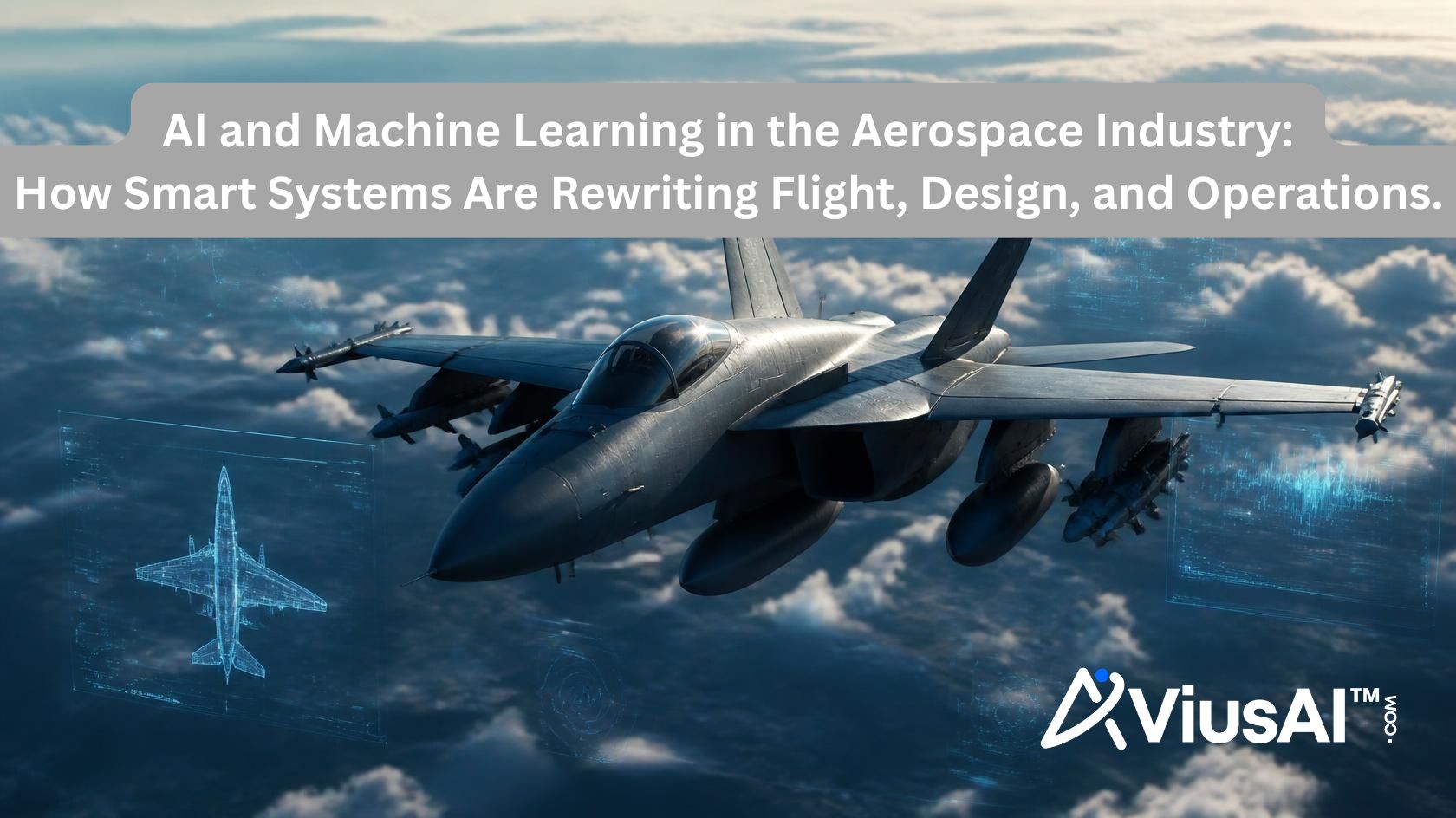
AI and Machine Learning in the Aerospace Industry:
How Smart Systems Are Rewriting Flight, Design, and Operations.
Artificial intelligence and machine learning are no longer futuristic extras in aerospace. They are becoming core tools that help engineers design better aircraft, help airlines run more efficiently, and help maintenance teams spot problems before they turn into costly failures.
Across commercial aviation, military aerospace, space systems, and manufacturing, AI and ML are changing how the industry thinks, builds, flies, and learns.
What makes aerospace such a powerful use case for AI is the sheer amount of data the industry produces. Aircraft generate streams of telemetry, engine health signals, weather inputs, maintenance logs, manufacturing inspection data, and operational records.
Humans can interpret only so much of it at speed, but machine learning can find patterns, correlations, and early warning signs that would otherwise remain hidden. The result is an industry that is moving from reactive decision-making to predictive and increasingly autonomous intelligence.
Why Aerospace Needs AI
Aerospace is one of the most complex industrial sectors in the world. Every aircraft is a system of systems: aerodynamics, propulsion, avionics, structural materials, software, fuel management, crew operations, air traffic coordination, and passenger service all have to work together safely. That complexity creates constant pressure to reduce risk, increase reliability, and control costs.
AI and machine learning help meet those demands by making sense of huge data sets faster than traditional methods. In aviation, they are already being used to optimize flight routes, predict congestion, support maintenance decisions, and improve safety management. In aerospace manufacturing, they are helping teams detect defects, improve inspection processes, and reduce waste. In space and defense applications, AI supports autonomous navigation, mission planning, sensor fusion, and rapid analysis of environment data.
Design and Engineering
One of the most valuable areas for AI in aerospace is design optimization. Aircraft design involves balancing weight, lift, drag, fuel burn, strength, manufacturability, cost, and certification requirements. That is a multi-variable problem with enormous computational demands, and ML can help explore better design options more efficiently.
Generative design and surrogate modeling are especially promising. Instead of relying only on manual iteration, engineers can train models on simulation and test data to predict how a design will behave before building it. This can accelerate the design of wings, airfoils, structural components, propulsion systems, and cabin elements. ML also supports more refined analysis of trade-offs, helping engineers narrow down candidate designs that meet performance goals while staying within safety and production constraints.
In propulsion and aerodynamics, machine learning can complement classical physics-based simulation. It can learn from CFD results, wind tunnel data, and flight-test data to identify performance trends or approximate expensive calculations. That does not replace engineering judgment, but it can reduce the time needed to evaluate options and make early-stage development more efficient.
Manufacturing and Quality Control
Aerospace manufacturing is unforgiving. A tiny flaw in a composite layer, weld, fastener, or machined part can lead to big problems later. That is why AI and ML are becoming increasingly useful on the factory floor, where they can monitor production in real time and detect anomalies far earlier than human inspection alone.
Computer vision systems can inspect components for scratches, cracks, warping, voids, alignment issues, or surface defects. Sensor-based machine learning can analyze vibration, acoustic, thermal, and pressure data to identify irregularities in machining or curing processes.
In composite manufacturing, for example, neural networks can be trained to recognize early signs of curing problems or micro-defects that may compromise structural integrity.
This is more than quality assurance; it is process intelligence. Instead of finding defects after the fact, manufacturers can identify where variation is entering the system and adjust production in real time. That means less scrap, fewer rework cycles, better consistency, and lower cost. In an industry where certification and traceability matter, the ability to document how a model arrived at an alert is also becoming important.
Predictive Maintenance
If there is one application that captures the practical power of ML in aerospace, it is predictive maintenance. Traditional maintenance schedules often rely on fixed intervals: inspect this part after so many flight hours, replace that component after so many cycles, check this system at a certain calendar date. That approach is reliable, but it can also be inefficient. Some parts get serviced before they need it, while others may fail unexpectedly between scheduled checks.
Machine learning changes that by using actual condition data. Engines, hydraulic systems, avionics, landing gear, and structural components produce sensor streams that can reveal early signs of wear, thermal drift, vibration anomalies, pressure changes, and performance degradation.
By learning normal operating patterns and identifying departures from them, ML models can forecast failures before they happen.
This has major implications for airline dispatch reliability, safety, and cost control. A maintenance team that knows a component is trending toward failure can schedule replacement during planned downtime instead of dealing with an unscheduled grounding. That means fewer delays, better parts planning, and improved asset utilization. For military fleets, where mission readiness is critical, predictive maintenance can also help keep aircraft available when they are needed most.
Flight Operations and Efficiency
AI is also reshaping flight operations. Airlines and operators use machine learning to optimize flight planning, route selection, fuel burn, and schedule reliability. By incorporating weather forecasts, air traffic density, airport congestion, historical delay patterns, and aircraft performance data, AI systems can recommend more efficient routes or adjust planning in response to changing conditions.
Fuel is one of the biggest operating expenses in aviation, and even small improvements in route efficiency can matter a lot at scale. ML tools can help dispatchers and flight planners reduce fuel consumption while maintaining safety margins and on-time performance. They can also support better crew scheduling and fleet assignment, which is especially valuable in large networks with tight turnaround times and complex constraints.
Another important use case is delay prediction. If airlines can anticipate which flights are most likely to be disrupted, they can proactively rebook passengers, reposition resources, and reduce the downstream impact of irregular operations. That makes the system more resilient and improves the customer experience.
Air Traffic and Airport Systems
Beyond individual aircraft, AI is increasingly being used at the network level. Air traffic management and airport operations are both information-dense environments where the cost of delay and miscoordination is high. ML models can help predict congestion, optimize gate allocation, improve turnaround planning, and support real-time decision-making across multiple stakeholders.
Airports can use AI to manage passenger flow, baggage handling, resource allocation, and maintenance of ground systems. Predictive models help identify bottlenecks before they spread, while optimization tools can improve how gates, tugs, crews, and service vehicles are deployed. On the air traffic side, AI can assist with route optimization and scenario analysis, especially when weather, traffic, or operational disruptions begin to pile up.
This does not mean AI replaces air traffic controllers or airport operations teams. Instead, it acts as a force multiplier by helping them process more information faster and prioritize action based on risk and likelihood.
Space and Defense Applications
The aerospace industry includes far more than commercial aviation. In defense and space, AI and ML are rapidly becoming strategic capabilities. Military aircraft and unmanned systems can use AI for autonomous navigation, sensor fusion, target recognition, mission planning, and threat assessment. In space systems, ML helps with satellite image analysis, anomaly detection, autonomous onboard decision-making, and predictive health management for spacecraft subsystems.
These applications are especially valuable because space and defense environments are often remote, contested, or hard to reach. Autonomous or semi-autonomous systems can reduce response time and improve resilience when communication windows are limited or when human oversight is delayed. In reconnaissance and surveillance, ML can help sift through enormous volumes of imagery and sensor data to prioritize what matters most.
That said, defense use also raises high-stakes questions about reliability, accountability, and operational control. The stronger the autonomy, the more important it becomes to define clear boundaries for human authority, override capability, and system verification.
Safety, Trust, and Certification
Aerospace is a safety-critical industry, so the biggest barrier to AI adoption is not imagination; it is trust. An AI system that performs well in a lab still has to prove itself in a regulated environment where failure can have catastrophic consequences. That means aerospace organizations must validate models carefully, document behavior, manage edge cases, and design systems that are robust under changing conditions.
Explainability matters here. If a model predicts a maintenance issue or recommends a route change, engineers and operators need to understand why. Black-box systems may be powerful, but they can be difficult to certify or defend in a safety review. As a result, many aerospace organizations are using AI in advisory roles first, where models support human decision-making rather than fully replacing it.
Data quality is another challenge. ML is only as good as the data it learns from, and aerospace data can be messy, incomplete, or siloed across departments and vendors. Integrating legacy systems with modern analytics platforms is often one of the biggest hurdles. In addition, cyber security becomes more important as AI tools connect operational data, maintenance systems, and cloud-based analytics.
The Human Factor
A common fear is that AI will make aerospace jobs obsolete. The more realistic view is that it will change them. Engineers, technicians, pilots, dispatchers, and analysts are likely to spend less time on repetitive inspection and spreadsheet work, and more time on oversight, interpretation, and strategic decisions.
That shift can be positive. A mechanic armed with predictive alerts and better diagnostics can work faster and with greater confidence. A design engineer with machine learning tools can explore more ideas before committing resources. A dispatcher with AI-driven forecasts can make smarter choices under pressure. The key is augmentation, not blind automation.
Training will matter a great deal. Aerospace workers will need to understand not only how to use AI tools, but also their limits. Companies that succeed will likely be the ones that pair strong technical systems with a culture of disciplined human review.
The Future of Aerospace AI
The next phase of AI in aerospace will likely move in several directions at once. First, predictive maintenance will become more accurate as more aircraft, engines, and systems feed high-quality data into learning models. Second, design and manufacturing will become more adaptive, with AI helping compress development cycles and improve quality control. Third, operational AI will become more integrated across flight planning, airport systems, and logistics.
We will also see more use of edge AI, where some processing happens onboard an aircraft, spacecraft, or ground asset rather than in a remote data center. That is useful when latency, bandwidth, or connectivity is limited. Another major trend is the blending of physics-based modeling with data-driven learning, which may create more reliable and interpretable AI systems for safety-critical applications.
Longer term, AI could also support more autonomous aircraft operations, smarter urban air mobility systems, and improved space mission autonomy. But the pace of change will be shaped by regulation, certification, public trust, and the industry’s deep commitment to safety.
Conclusion
AI and machine learning are becoming essential tools in aerospace because they fit the industry’s biggest needs: better safety, greater reliability, lower cost, and faster decision-making. Whether the application is aircraft design, predictive maintenance, manufacturing inspection, route optimization, or autonomous mission support, the pattern is the same: AI turns large volumes of aerospace data into actionable intelligence.
The technology is powerful, but its success depends on careful implementation. In aerospace, the goal is not to use AI simply because it is new. The goal is to use it where it improves outcomes, strengthens safety, and helps people do their jobs better. That is why AI and ML are not just changing aerospace, they are becoming part of the industry’s operating logic.