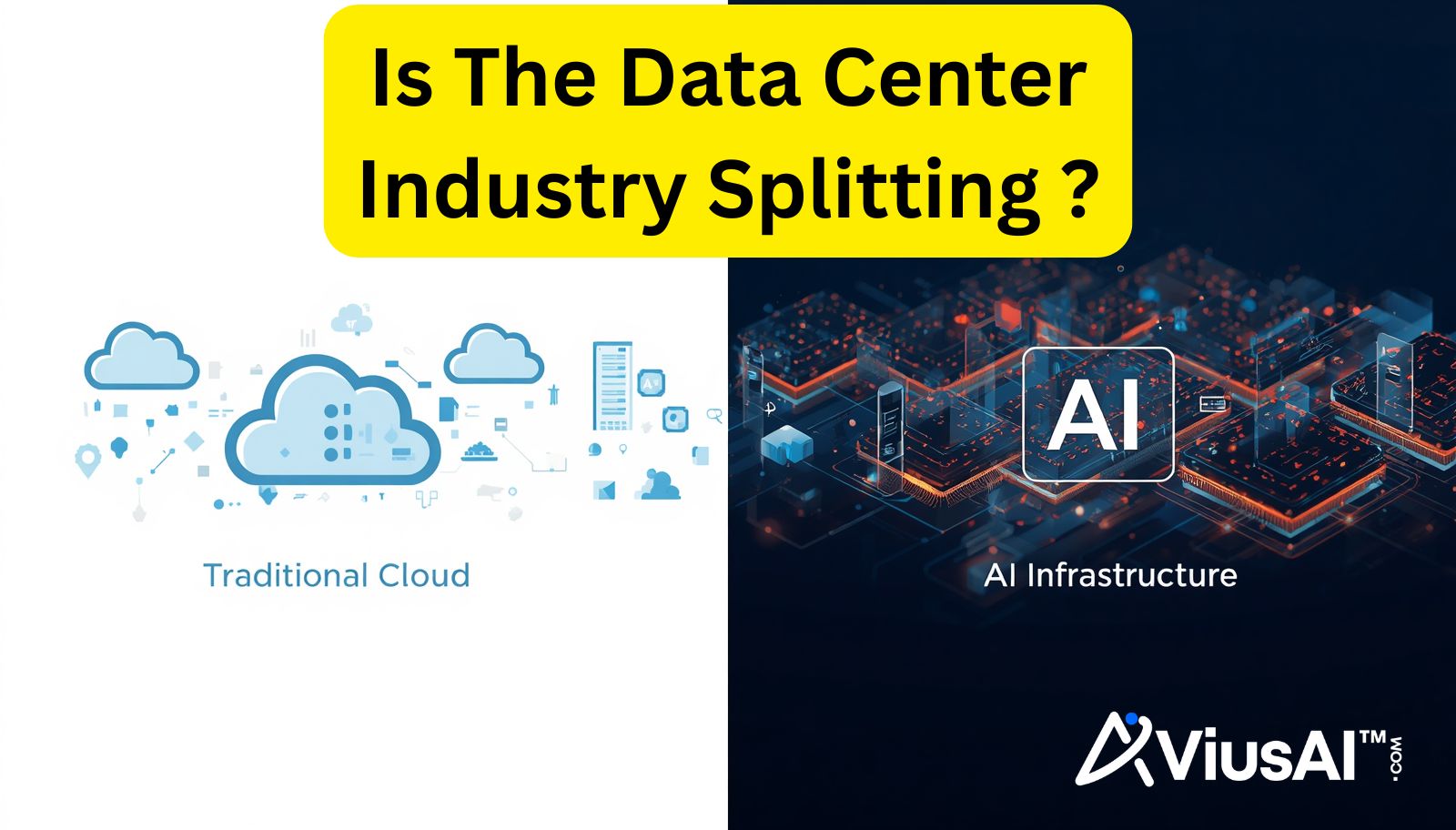
The data center industry is no longer one unified machine quietly powering the internet. It is splitting fast into two distinct worlds, each with its own priorities, infrastructure, and long-term consequences. If you are watching AI, national security, or even real estate trends, this divide matters more than most people realize.
The Great Split Has Already Started
For decades, data centers followed a predictable evolution. Build larger facilities, improve uptime, increase density, and support cloud computing. Hyperscalers like Amazon, Microsoft, and Google drove massive growth, but the core mission stayed consistent: store data, run applications, and deliver services efficiently.
That model is now breaking apart.
Today, two fundamentally different types of data centers are emerging:
- Traditional cloud and enterprise infrastructure
- AI-driven, high-density compute infrastructure
At first glance, that may sound like a simple upgrade cycle. It is not. These two paths are diverging in ways that impact power grids, real estate, supply chains, and even geopolitics.
Side One: Traditional Data Centers (The Old Guard)
Traditional data centers are what most people think of when they hear “the cloud.” These facilities handle:
- Web hosting
- Enterprise applications
- Storage and backup
- SaaS platforms
- Streaming and general internet traffic
They are optimized for efficiency, uptime, and predictable workloads. Power density is relatively stable, typically ranging between 5–15 kW per rack. Cooling systems are mature, and infrastructure is standardized.
These facilities are still critical. They are not going away.
But they are no longer the center of gravity.
Growth in this segment is slowing compared to what is happening on the AI side. Companies are still expanding traditional cloud capacity, but it is becoming more incremental, more optimized, and less revolutionary.
Think of it like conventional military logistics – essential, reliable, but not where the next major strategic shift is happening.
Side Two: AI Data Centers (The New War Machine)
AI data centers are a completely different beast.
Instead of handling millions of small, distributed tasks, these facilities are built to run extremely dense, power-hungry workloads like:
- Large language model training
- Real-time AI inference
- Autonomous systems processing
- Advanced analytics and simulation
The difference is not incremental – it is exponential.
AI racks can demand 50–100 kW or more per rack, with some next-gen designs pushing even higher. That is not a small upgrade. That is a complete redesign of how data centers are built.
Key differences include:
- Massive GPU clusters instead of CPU-heavy workloads
- Liquid cooling instead of traditional air cooling
- Extreme power requirements, often requiring dedicated substations
- Network fabrics optimized for ultra-low latency between nodes
This is closer to building a power plant combined with a supercomputer than a traditional server facility.
Power Is the New Battleground
If you want to understand why the industry is splitting, look at power.
Traditional data centers were already energy-intensive, but AI infrastructure is on another level. A single AI campus can consume as much electricity as a small city.
This creates immediate constraints:
- Utilities cannot scale fast enough in many regions
- Power permitting timelines are slowing deployments
- Grid stability is becoming a concern
- Energy sourcing (nuclear, renewables, natural gas) is now strategic
In some areas, data center projects are being delayed or denied simply because the grid cannot support them.
This is where the split becomes obvious.
Traditional data centers can still operate in established hubs like Northern Virginia, Dallas, or Phoenix with manageable upgrades.
AI data centers are being forced to go where power is available, not where it is convenient.
Geography Is Changing Fast
Because of power constraints, the geography of data centers is shifting.
Traditional hubs are hitting limits. Meanwhile, new regions are emerging based on:
- Access to cheap and abundant energy
- Favorable regulations
- Available land for large-scale campuses
States like North Carolina, Georgia, and parts of the Midwest are becoming increasingly attractive. This is not just about cost – it is about survivability of large-scale deployments.
For someone tracking relocation or real estate trends, this matters. Data centers bring:
- Infrastructure investment
- Jobs (especially in construction and maintenance)
- Long-term economic impact
But AI data centers also bring challenges:
- Increased strain on local utilities
- Environmental concerns
- Zoning conflicts
Communities are starting to push back in some regions, especially when power consumption threatens residential growth.
Cooling: From Air to Liquid
Cooling is another major dividing line.
Traditional data centers rely heavily on air cooling – hot aisle/cold aisle configurations, CRAC units, and standard HVAC systems.
AI workloads generate far more heat. Air cooling alone is no longer sufficient at scale.
This has driven rapid adoption of:
- Direct-to-chip liquid cooling
- Immersion cooling (servers submerged in specialized fluids)
- Advanced thermal management systems
This shift is not trivial. It changes:
- Facility design
- Maintenance procedures
- Supply chains for hardware
- Skill requirements for technicians
In other words, the workforce itself has to evolve.
Supply Chain Pressure and Hardware Wars
The split is also being driven by hardware.
Traditional data centers rely on CPUs and standardized server components. Supply chains are relatively stable.
AI data centers depend heavily on GPUs and specialized accelerators. Right now, that means companies like NVIDIA are dominating the market.
This creates several issues:
- Limited supply of high-end chips
- Long lead times for new deployments
- Rising costs for infrastructure buildouts
- Strategic competition between companies and even nations
This is not just a business issue – it is a national security concern.
Control over AI compute capacity is increasingly viewed as a strategic asset, similar to control over energy or defense systems.
Hyperscalers Are Splitting Themselves
Even within the same company, the split is visible.
Amazon, Microsoft, and Google are effectively running two parallel strategies:
- Expanding traditional cloud services
- Building dedicated AI infrastructure at unprecedented scale
These are not interchangeable systems.
AI workloads cannot simply be “plugged into” traditional cloud environments without major performance penalties. That is why companies are building specialized AI clusters, often separated physically and operationally.
This is a major shift in how cloud providers think about infrastructure.
Edge Computing Complicates the Picture
While the industry splits into traditional and AI-heavy data centers, a third layer is emerging: edge computing.
Edge data centers are smaller, distributed facilities designed to process data closer to the source. They are critical for:
- Autonomous vehicles
- Military and defense systems
- IoT networks
- Real-time analytics
These facilities often blend characteristics of both sides:
- Lower latency requirements like AI systems
- Smaller scale like traditional deployments
This adds complexity to an already fragmented landscape.
National Security Implications
This is where things get serious.
AI infrastructure is quickly becoming a national priority. Governments are paying close attention to:
- Where data centers are built
- Who controls the hardware
- How data is processed and secured
The split in the industry mirrors a broader strategic divide:
- Commercial cloud services supporting global business
- AI infrastructure supporting technological dominance
Countries that can build and sustain large-scale AI data centers will have a significant advantage in:
- Defense systems
- Intelligence operations
- Economic competitiveness
This is not hypothetical. It is already shaping policy decisions and investment strategies.
Real Estate and Investment Shifts
For investors and developers, the split creates two very different opportunities.
Traditional data centers:
- More predictable returns
- Established markets
- Lower risk but slower growth
AI data centers:
- Higher risk due to power and infrastructure constraints
- Massive capital requirements
- Potential for outsized returns
Land near power sources is becoming extremely valuable. Access to transmission lines, substations, and energy generation is now a key factor in site selection.
This is changing how deals are structured and where capital is flowing.
Workforce Transformation
The people working in data centers are also affected.
Traditional roles focused on:
- Network management
- Hardware maintenance
- Facility operations
AI data centers require:
- Advanced cooling expertise
- High-performance computing knowledge
- Specialized hardware handling
Training pipelines are not fully caught up yet, which creates a skills gap.
This is an opportunity for veterans and technically trained individuals. The structured environment, operational discipline, and systems thinking required in these facilities align well with military experience.
Environmental Pressure Is Increasing
As power consumption rises, so does scrutiny.
AI data centers are facing questions about:
- Carbon footprint
- Water usage for cooling
- Impact on local communities
Companies are responding by investing in:
- Renewable energy contracts
- On-site power generation
- More efficient cooling technologies
But the reality is that demand is growing faster than efficiency gains.
This tension is not going away.
What Happens Next
The split in the data center industry will continue to widen.
We are likely to see:
- Dedicated AI campuses with their own power infrastructure
- Increased government involvement in siting and regulation
- More regional diversification of data center locations
- Continued pressure on supply chains for AI hardware
Traditional data centers will remain essential, but they will no longer define the industry.
AI infrastructure will.
A Simple Way to Think About It
If you want a clear mental model, think of it like this:
- Traditional data centers are highways – reliable, widespread, built for steady traffic.
- AI data centers are aircraft carriers – massive, power-intensive, and strategically critical.
Both are necessary. But only one is reshaping the balance of power.
The data center industry is not just evolving – it is dividing into two distinct ecosystems with different rules, risks, and strategic importance. Understanding that split is key if you are watching technology, infrastructure, or where the next major economic shifts are going to hit.