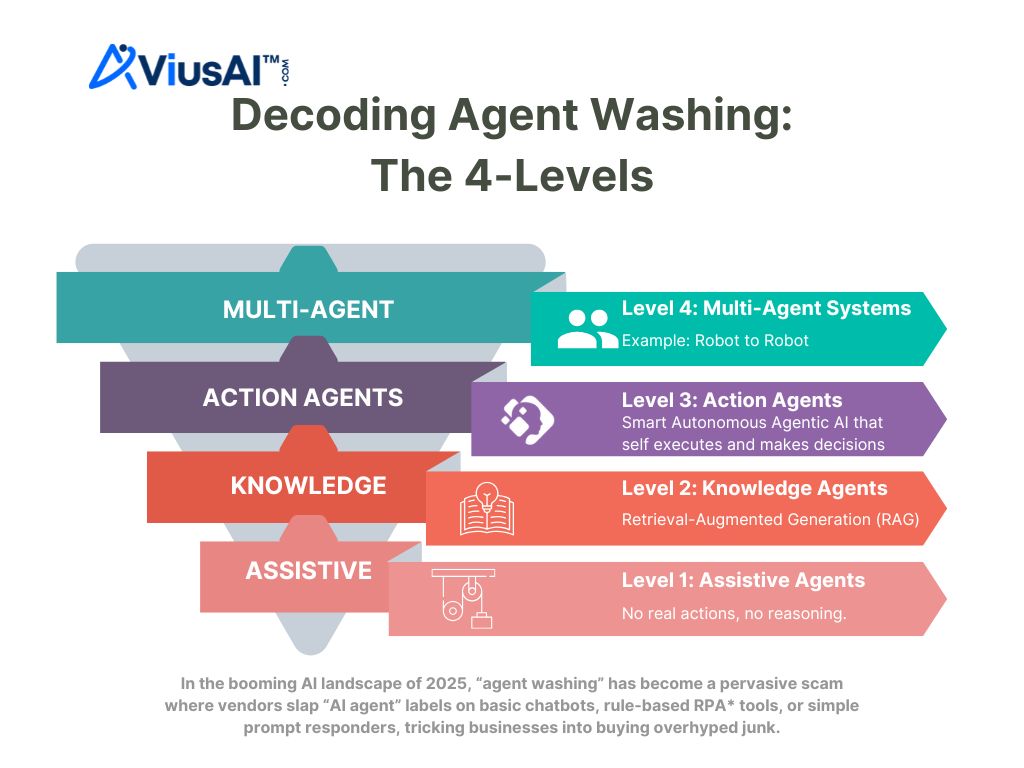
What Is Agent Washing? Agent washing is the deceptive practice of marketing basic automation tools – often simple rule-based systems or simple chatbots – as sophisticated AI agents with high levels of autonomy, reasoning, and decision-making capabilities, leading enterprises to overspend on under-delivering solutions. “Agent washing” has become a pervasive scam where vendors slap “AI agent” labels on basic chatbots, rule-based Robotic Process Automation (RPA) tools, or simple prompt responders, tricking businesses into buying over-hyped junk.
This mirrors green-washing or AI washing, but targets the Agentic promise of autonomous, reasoning systems – leading enterprises to waste millions on tools that crumble under real workloads.
Keep reading for the landmark SEC case against Presto Automation (QSR solutions) “Presto made false and misleading claims about Presto Voice” – U.S. Security and Exchange Commission.
Gartner warns that over 90% of so-called “AI agents” are washed – repackaged Level 1 assistive tools marketed as sophisticated Level 4 multi-agent orchestrators. When in fact, true Agents reason, plan, act autonomously, adapt to context, and integrate tools like calendars or CRMs, unlike rigid bots that fail on interruptions or nuance.
For front desks drowning in calls, emails, and bookings, agent washing means endless voicemails and missed revenue; Avius AI (a true agent solution) flips this by deploying adaptive voice AI that empathizes, transcribes, routes, and follows up seamlessly.
The First Enforcement Action
This misrepresentation creates business risks like wasted budgets, mismatched expectations, operational failures, and regulatory scrutiny from bodies such as the FTC and SEC, as seen in cases like Presto Automation’s inflated claims. To combat it, enterprises should evaluate tools using a 4-level autonomy framework (from Level 1 assistive agents to Level 4 multi-agent systems) and demand transparency on deterministic vs. probabilistic components, failure modes, and real-world evidence rather than hype. SEC Summary.
The SEC case against Presto Automation marks the first enforcement action targeting “AI-washing” in a public company, where firms exaggerate AI capabilities to mislead investors. Presto falsely portrayed its Presto Voice drive-thru AI as proprietary technology that eliminated human order-taking, despite requiring substantial human intervention later.
This precedent signals heightened SEC scrutiny on unsubstantiated AI claims in filings and statements, hopefully thereby curbing hype-driven investments across the sector.
Why Agent Washing is a Problem
Agent washing, akin to “AI washing”, involves companies exaggerating the autonomy and intelligence of AI agents to mislead customers and investors about their true capabilities. This practice erodes trust when over-hyped systems underperform in real-world scenarios, as seen with products labeled “AI-powered” that rely heavily on human intervention or basic automation. Source.
Key Risks to Businesses and Consumers
It distorts markets by prioritizing hype over substance, leading to misguided investments and customer backlash, much like the dot-com bubble or greenwashing scandals. Consumers face deception through vague claims that ignore failure modes, edge cases, or required oversight, resulting in unreliable tools and wasted resources. Source.
Long-Term Industry Damage
Over time, agent washing stifles genuine innovation by creating skepticism toward legitimate AI advancements and invites regulatory scrutiny for false advertising. Companies risk reputational harm and legal challenges when demo-perfect performances fail in production, ultimately harming the broader adoption of trustworthy AI agents. Source.
Similar Washing Trends From The Past
We saw this same trend with Cloud Washing. Cloud washing involved vendors marketing legacy software as “cloud-based” by simply hosting it on virtual machines without redesigning for true cloud traits like elasticity or native services. Examples highlight this in backup, storage, and Enterprise Resource Planning (ERP) sectors.
Notable Examples:
- CommVault Metallic: A SaaS wrapper around traditional on-premises backup software running in cloud VMs, leading to higher costs, downtime for updates, and inherited security risks from Windows-based architecture.
- Western Digital – “My Cloud”: Branded as “personal cloud storage” but essentially a Network Attached Storage (NAS) device for local files, lacking public cloud scalability or resource pooling.
- ERP Vendors: Many rebrand on-premises enterprise apps as cloud-ready without self-service, multi-tenancy, or distributed architecture, often requiring custom integrations.
We saw this same trend during the rise of the vapor liquid industry, where Chinese synthetic blends were sold as “USA Made, All Natural” while not only being made overseas, they were loaded with harmful impurities making them far from “all natural”.
The same trend was also spotted at the advent of the Cannabidiol/Cannabinoids market where “hemp seed oil” was marketed as having the same effect as “CBD”. Not only did that result in “hemp oil” being wrongfully and loosely referred to as “CBD” products, it also created mass consumer confusion. Hemp seed oil in fact lacks cannabinoids all together.
Decoding Agent Washing: The 4-Levels
Level 4: Multi-Agent Systems
Amazon’s warehouse fulfillment system exemplifies a Level 4 multi-agent system. Essentially, orchestrators (i.e. robots) delegating to sub-agents (i.e. robots) for enterprise workflows. Source.
How It Works
Hundreds of Kiva robots act as individual agents retrieving shelves, coordinated by a task allocator agent for assignments and a traffic controller agent to prevent collisions and manage real-time data like inventory and delays. These agents communicate autonomously through a central system, adapting dynamically to optimize order fulfillment across the warehouse.
Level 3: Action Agents
Avius AI operates as Agentic conversational AI focused on voice interactions, emphasizing perception, reasoning, empathy, and human context understanding for customer engagement like call handling and decision-making. It supports features such as simultaneous call processing up to 200 lines, call transfers based on criteria, and contextual awareness. It’s Level 3 Action Agents integrate with tools and APIs for tasks like workflows, triggers, or transfers.
Here, autonomy kicks in: tool-calling for emails (Tool-calling for emails means letting an AI agent trigger concrete email-related actions), API updates, or bookings, with planning and error correction. These real action agents perceive calls via voice analysis, reason through objections, react with empathy and act by syncing calendars (for example), and adapt mid-conversation.
Why it’s not yet Level 4. Level 4 requires coordination among networks of specialized agents for complex, orchestrated goals, which Avius AI is in research and development with. Internal testing has demonstrated that agent to agent autonomy is possible, however, the current focus is single-agent reasoning to machine (transfer to PBX for example) with autonomy.
Multi-agent collaboration and orchestration remains to be considered and developed as the industry evolves.
Level 2: Knowledge Agents
Retrieval-Augmented Generation (RAG) enhanced tools pull from docs for context-rich responses, blending rules with light AI. Still not agentic – they advise, they don’t execute. Agent washers call these “smart receptionists,” but often can’t handle live voice nuances or emotional cues. Most, if not all, require a form of human intervention.
Level 1: Assistive Agents
These are prompt-based chatbots offering advice or simple outputs – no actions, no reasoning. Vendors wash them as “agents” by adding buzzwords, but they stall on multi-step tasks like booking a conflicted appointment. Example: A basic bot drafting an email but unable to send it or track replies.
Human augmentation in Agentic AI frameworks typically aligns with lower autonomy levels (Level 1-2), where humans provide continuous oversight, prompts, or interventions, rather than full independence seen in Level 3/4.
In the 4-level agent washing framework, human-augmented systems fall under Level 1 (Assistive Agents) or Level 2 (Knowledge Agents), as they rely on human input for basic processing or context without autonomous tool use or multi-agent coordination. Most if not all, require a form of human intervention.
A lot of Human-augmented AI voice solutions in UCaaS/CCaaS (contact centers) that we have seen in the marketplace primarily align with Level 2 (agent augmentation via coaching and scripting), building on Level 1 basics.
The Risks: Millions Lost to Hype
Agent washing isn’t just harmless – it’s a business killer. Enterprises overspend on non-scalable tools, facing FTC/SEC scrutiny for deceptive claims akin to securities fraud. Compliance nightmares arise when “autonomous” bots leak data or hallucinate actions without guardrails.
For front desks, washed agents mean dropped calls (up to 30% failure rates), poor CX from robotic replies, and zero ROI on promised 24/7 coverage. Forbes notes Robotic Process Automation (RPA) relabeled as agents lacks reasoning, failing e-commerce orders or sales follow-ups.
Real costs? Wasted pilots, integration headaches, and talent diverted from actual high value work.
Lessons Learned from the Presto Case and More
Be cautious of these expectation gaps:
- Selling “full autonomy” but actually providing rigid automation – like Presto’s so-called “AI” that still relied on humans for over 70% of orders.
- Using the phrase “AI-powered” without clarifying how autonomous it really is – a buzzword smokescreen that dodges specifics about whether the system is rule-based or probabilistic.
- Marketing low-level automation as if it were high-level intelligence – rebranding structured workflows as adaptive or self-learning systems.
- Ignoring discussion of failure points, edge cases, or human involvement – every level of autonomy includes built-in limits and oversight needs.
- Failing to explain how different components interact – glossing over the relationship between deterministic logic and probabilistic AI.
- Showing off perfect demos that crumble in real-world conditions – smooth, scripted showcases that don’t survive messy or unpredictable inputs in production.
- Claiming “reasoning” without demonstrating true adaptability – executing preset instructions isn’t the same as making context-aware decisions.
“Despite $30–40 billion in enterprise investment into GenAI, this report uncovers a surprising
result in that 95% of organizations are getting zero return. (…)Most organizations fall on the wrong side of the GenAI Divide, adoption is high, but disruption is low. Seven of nine sectors show little structural change.” Says MIT
Red Flags of Agent-Washed Vendors
- Vague Demos: Fragile scripted shows in sandboxes, no live chaos handling.
- No Transparency: Hides “black box” logic, failure modes, or tool limits.
- Overpromised Autonomy: Claims multi-step execution without memory or adaptation.
- RPA Rebrands: Rule-followers lacking context/emotion detection.
- Missing Metrics: No evidence of 80%+ resolution rates in production.
“Copilots” are also a subtle form of washing – AI assistants needing constant prompts are simply not autonomous agents.
Avius AI: The Anti-Washing Front Desk Revolution
Avius AI embodies true agency for front desks overwhelmed by SMB/enterprise demands. Launched with low-cost automation, it handles every inbound call 24/7, qualifying leads (e.g. for a sales driven organization) with customization such as data collection points, and custom mission goals such as booking appointments, routing calls instantly and more.
Core Agentic Features
- Perception & Reasoning: Analyzes voice tone for urgency/emotion, maintains context across channels.
- Autonomous Actions: Books jobs, sends confirmations, transcribes calls sent to emails – no human loops.
- Adaptation: Learns from interactions, fixes errors like rescheduling conflicts.
- Multi-Modal: Voice + post-actions (texts/emails), equaling at minimum, 4.2 Full Time Employees (FTEs).
Considering traditional methods, Avius AI can equate up to a 17X savings vs. human staff. Including up to 90% automation on routine tasks thereby freeing humans for high value tasks. Unlike washed systems templating replies, Avius AI generates natural, personalized conversations boosting customer satisfaction.
Real-World Proof: Avius vs. Washed Competitors
| Feature | Agent-Washed Tools | Avius AI |
|---|---|---|
| Autonomy | Prompt-dependent, rigid scripts | Self-plans, executes, self-corrects |
| Voice Handling | Text-only or basic IVR | Human-like intonation, emotion detect |
| Capacity | Defendant on human capacity | 200 Calls Simultaneously |
| Integrations | Surface APIs, no workflows | API integration/workflow triggers/post-actions |
| Cost | High setup, low scale | 17X cost savings, instant deployment capable |
| Managed Solution | Depends on application | Yes |
Building the Future: Hybrid Agentic Strategies
Pure autonomy risks errors; hybrids win with deterministic rails + probabilistic smarts. Avius AI nails this: safe voice AI with enterprise controls, scaling from SMB trades to the front end customer experience (CX) solution in front of contact centers.
While lower level systems fail goals – Avius AI thrives in the wild: difficult conversations, emotionally charged scenarios requiring empathy to build trust, on demand and off script knowledge, and fluid objections handling to name a few.
Vendor Evaluation Checklist for Buyers
- Demand Level Proof: Role play with their demo’s live and on demand. You can do this with Avius AI by calling (855) 284-8196.
- Live Stress Test: Simulate 200+ simultaneous calls yourself.
- ROI Evidence: Production metrics, that result in operational upgrades.
- Feature Transparency: What does it actually do?
- Smart Tests: Can it handle your customer going off script autonomously?
- Voice Focus: Test real life customer conversations, not just hypothetical.
Call to Action: Ditch the Wash, Embrace Real Agency
As Agent washing peaks, Avius AI stands apart and fortifies front desks with proven, Agentic AI muscle. Visit AviusAI.com, call the demo at (855) 284-8196 and prove the difference – transform chaos to efficiency today. No hype, just results.
Additional Sources:
SEC Administrative Proceedings